AI in business strategy is evolving rapidly across the Asia Pacific region, which is swiftly solidifying its position as a global economic leader, AI is emerging as a crucial catalyst for this growth. The region’s AI market is on track to reach a substantial USD 244 billion by 2025, underscoring the urgent need for organisations to adapt and scale their AI capabilities effectively to remain competitive. The critical question has evolved from whether to embrace AI to how to implement it through a clear AI in business strategy for long-term viability.
Here are 5 essential trends that will shape the AI landscape throughout 2025 and beyond.
1. Strategic AI Deployment in Business Strategy
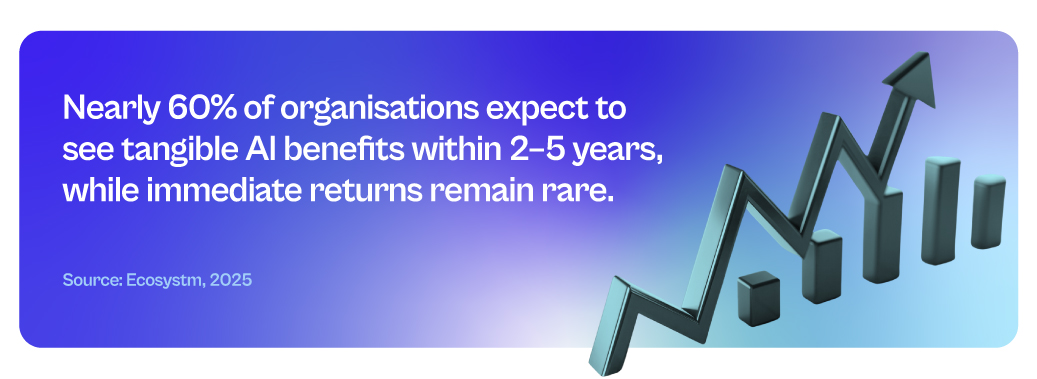
AI is no longer a buzzword, but Asia Pacific’s transformation engine. It’s reshaping industries and fuelling growth. Initially, high costs and complex ROI pushed leaders toward quick wins. Now, the game has changed. As AI adoption matures, the focus is shifting from short-term gains to long-term, innovation-driven strategies.
Generative AI in business is at the heart of this shift, moving beyond the periphery to power core business functions and deliver competitive advantage.
Organisations are rethinking AI investments, looking beyond pure financials to consider the impact on jobs, governance, and data readiness. The AI journey is about balancing ambition with practicality.
2. Optimising AI: Tailored Open-Source Models
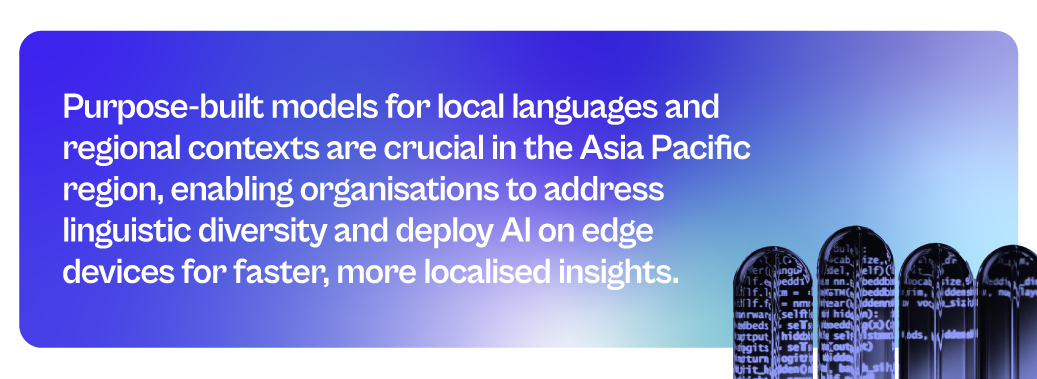
Smaller, open-source AI models and specialised AI tools will gain momentum as organisations seek efficiency, flexibility, and sustainability in their AI strategies.
Unlike LLMs, which require high computational power, smaller, task-specific models offer comparable performance while being more resource-efficient. This makes them ideal for organisations working with proprietary data or limited computational resources.
Beyond cost and performance, these models are more energy-efficient, addressing growing concerns about AI’s environmental impact.
3. Centralised Tools for Responsible Innovation
Navigating the increasingly complex AI landscape demands unified management and governance. Organisations will prioritise centralised AI governance tools and frameworks to tame the chaos of diverse AI solutions, ensuring compliance (think EU AI Act) while boosting transparency and security.
Automated AI governance tools and lifecycle management tools will streamline oversight, providing real-time tracking of model performance, usage, and issues like drift.
By using flexible developer toolkits and vendor-agnostic strategies, organisations can accelerate innovation while maintaining adaptability, as the technology evolves.
4. Supercharging Workflows With Agentic AI
Organisations will embrace Agentic AI to automate complex workflows and drive business value. Traditional automation tools struggle with real-world dynamism, but AI-powered agents offer a flexible solution. They empower autonomous task execution, intelligent decision-making, and adaptability to changing circumstances.
These agents, often using Agentic AI powered by Generative AI, understand complex instructions and learn from experience. They collaborate with humans, boosting efficiency, and adapt to disruptions, unlike rigid traditional automation.
AI workflow automation through agentic design is key to redefining work, enabling agility and innovation.
5. From Productivity to People
The focus of AI conversations will shift from simply boosting productivity to using AI for human-centric innovation that transforms both employee roles and customer experiences.
For employees, AI will handle routine tasks, enabling them to focus on creativity and innovation. Education and training will be crucial for a smooth transition to AI-powered workflows.
For customers, AI is evolving to offer more empathetic, personalised interactions by understanding individual emotions, motivations, and preferences. Organisations are recognising the need for transparent, explainable AI to build trust, tailor solutions, and deepen engagement.

Hit or miss AI experiments have leaders demanding results. In this breakneck AI landscape, strategy and realism are your survival tools. A pragmatic approach? High-impact, achievable goals. Know your capabilities, prioritise manageable projects, and stay flexible. The AI winners will be those who champion human-AI collaboration, embed ethical AI in business, and never stop researching.

Authored By: