Organisations have spent years investing in data, yet many still struggle to answer relatively simple questions: Where does critical data reside? Who is responsible for it? How is it being used? And what influences the decisions being made from it?
These questions are becoming harder to ignore as AI becomes embedded in everyday operations. What was traditionally seen as a specialist data concern is now closely tied to business performance, customer trust, operational resilience, and the ability to scale new initiatives with confidence.
The challenge is not a lack of governance frameworks. Many organisations already have policies, controls, and accountability structures in place. The issue is that the environments those frameworks were designed for are changing rapidly.
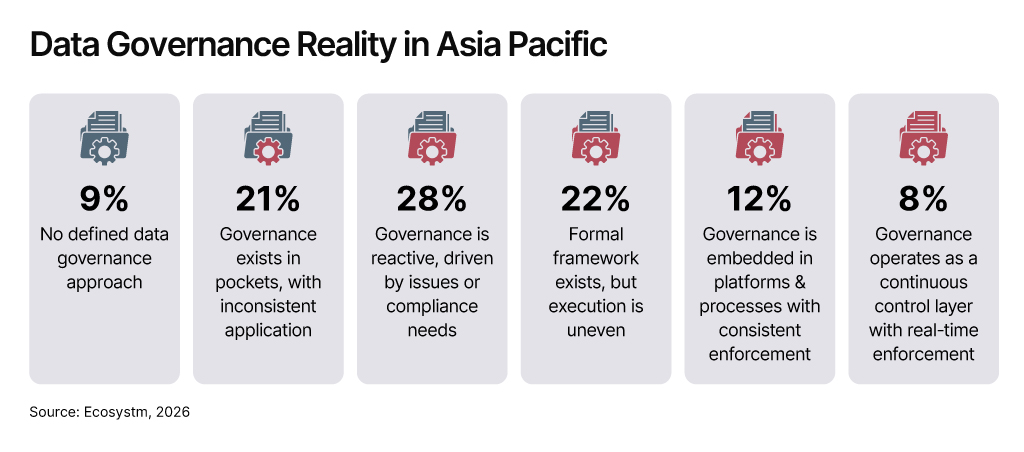
Data now flows across cloud platforms, SaaS applications, partner ecosystems, AI models, and jurisdictions. Business processes depend on interconnected systems rather than standalone applications. Decisions that follow clearly defined workflows are being shaped by algorithms, automation, and AI-generated recommendations.
As a result, governance is not confined to managing data assets in isolation; it is also about understanding how information moves through complex operating environments.
Governance Is Becoming Part of the Operating Model
Many organisations still approach governance as a separate discipline that sits alongside business and technology operations. Policies are written, controls are defined, and compliance is reviewed periodically.
In practice, however, governance is becoming intertwined with the way systems are designed and operated.
Questions around data access, accountability, retention, lineage, and use are being addressed through architecture decisions, platform design, and operational controls. Organisations are finding that it is difficult to demonstrate accountability if visibility only exists at the policy level while day-to-day activity takes place across dozens of disconnected systems.
For enterprise leaders, this changes the conversation. Governance is not simply about satisfying regulators or reducing risk exposure. It has a direct impact on how confidently organisations can introduce new products, deploy AI capabilities, share information across partners, and scale digital initiatives.
AI Is Changing What Needs to Be Governed
Traditional governance programs were largely built around structured data and predictable business processes.
AI expands both the volume and variety of information being used. Organisations are working with documents, conversations, images, video, sensor data, embeddings, and machine-generated outputs. More importantly, AI systems can derive new insights, patterns, and recommendations from combinations of data that were never originally intended to be analysed together.
This creates a different governance challenge.
Leaders may understand the source of a dataset but have less visibility into how that information influences model behaviour, recommendations, or automated decisions. Accountability becomes harder to establish when outcomes are generated through multiple layers of systems, models, and external services.
The conversation therefore extends beyond data quality and access management. It increasingly includes explainability, traceability, and confidence in how decisions are being formed.
Visibility is Becoming More Valuable than Documentation
Governance has always relied heavily on documentation. Organisations documented policies, ownership structures, controls, and compliance processes to demonstrate accountability.
Documentation remains important, but it only provides part of the picture.
Enterprise leaders are placing greater emphasis on visibility into what is actually happening inside operational environments. They want to understand how data moves between systems, who is accessing it, how AI applications interact with it, and whether controls are functioning as intended.
There has been a shift in how organisations think about risk and accountability. The ability to observe and understand live environments is becoming just as important as the ability to define governance requirements on paper.
In many cases, confidence comes less from what organisations say they control and more from what they can demonstrate.
Sovereignty is Bringing Governance into Strategic Discussions
Questions around data sovereignty have added another layer of complexity.
Infrastructure decisions that were considered largely technical carry business implications. Organisations operating across multiple markets must navigate different requirements around data residency, privacy, AI accountability, and regulatory oversight.
At the same time, geopolitical considerations are influencing how organisations think about technology dependencies, cloud providers, ecosystem partnerships, and digital resilience.
These considerations affect more than compliance. They influence expansion plans, customer relationships, procurement decisions, and long-term operating flexibility.
This makes data governance part of broader strategic discussions about where organisations operate, who they partner with, and how they maintain control over critical assets and information.
Precision Matters More than Coverage
Organisations are also recognising that governance does not need to be applied uniformly across every system, dataset, and process.
Large enterprises operate within environments shaped by years of acquisitions, cloud adoption, legacy technology, and evolving business requirements. Attempting to redesign everything at once is rarely realistic.
Instead, attention is being focused on areas where governance failures would create the greatest operational, regulatory, financial, or reputational impact. Sensitive data, critical business processes, customer-facing AI applications, and regulated environments often become the priority.
This allows organisations to direct effort where accountability and control matter most, while maintaining enough flexibility to continue evolving elsewhere.
Understanding Before Scaling
Most discussions about AI focus on use cases, productivity gains, and competitive advantage. Those conversations are important, but they often assume that organisations have sufficient visibility into the environments that support them.
In reality, the ability to scale AI successfully depends on a deeper understanding of how information moves through the business, how decisions are made, where accountability resides, and how trust is maintained across customers, regulators, employees, and partners.
This is why governance is attracting attention far beyond traditional risk and compliance functions.
Governance is becoming a question of organisational understanding. The organisations best positioned to scale AI and digital transformation will not necessarily be those with the most comprehensive frameworks. They will be the ones with the clearest view of their own operating environment and the confidence to act on it.