For most line of business leaders, AI has moved past the experimentation and proof of concept stages. The question sitting on the table now is more direct: why isn’t AI translating into measurable business value at scale, even with strong activity and investment behind it?
Across Asia Pacific, organisations are actively deploying AI across functions and processes.
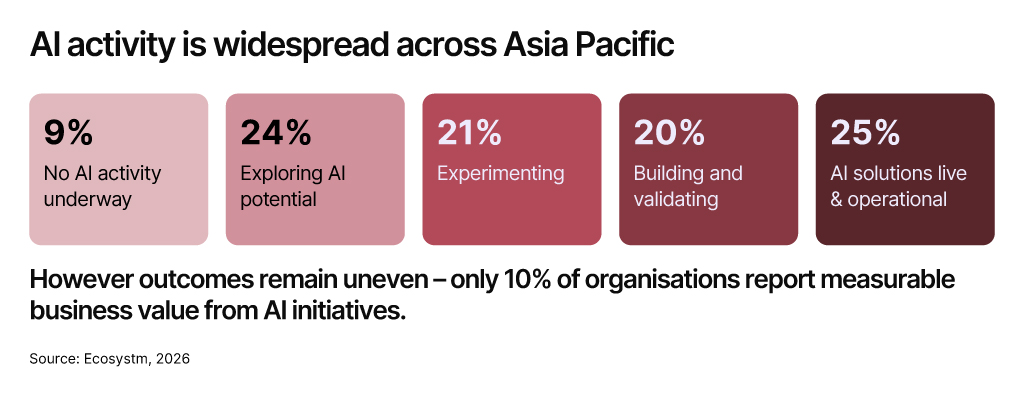
The pattern is fairly consistent: activity is high, pilots are plenty, and budgets are committed, but only a small share of organisations are seeing sustained, enterprise-level outcomes.
The real issue is not the level of activity. It is how AI is being absorbed into the organisation, and whether the operating environment underneath it is fit for purpose.
AI does not sit neatly inside one function or team. It surfaces how the organisation is actually built. And that is where the friction shows up – in execution speed, cost of delivery, quality of insight, and confidence in decisions.
AI is Exposing How Systems Actually Behave
As AI scales, the separation between IT (infrastructure, platforms, systems) and data (pipelines, governance, analytics) starts to blur in day-to-day execution. These areas were often treated as back-end concerns. With AI, they sit much closer to business outcomes.
Every AI outcome depends on a chain of connected decisions:
- Where data sits and how it is structured
- How quickly it can be accessed and processed
- How systems connect across environments
- What governance allows or restricts
- How infrastructure behaves under load
Taken individually, these look technical. Together, they determine whether AI moves from pilot to production in a meaningful way.
What is taking shape is less about overlap and more about dependency: IT and data decisions are now part of the same system whether the organisation is structured that way or not.
Those dependencies are now surfacing as everyday execution constraints, and that is what is pulling IT and data closer together.
1. Data readiness is slowing execution
AI adoption is picking up, but data readiness varies widely and that difference shows up quickly in delivery timelines.
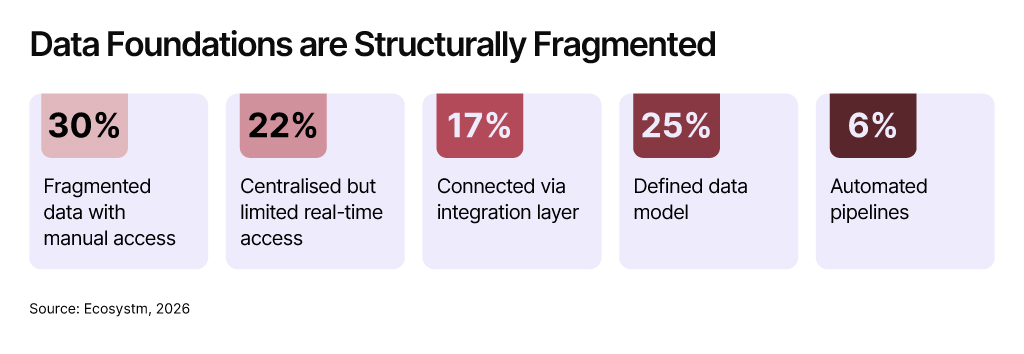
The reason often points to data quality or governance. The reality sits deeper in structure. Most organisations already hold the data needed for AI use cases. The challenge is that it is spread across legacy systems, cloud platforms, and business applications that were never designed to work together.
So before anything meaningful happens with AI, time gets spent locating, reconciling, and aligning data. That work rarely appears in strategy discussions, but it is visible in how long it takes to move from idea to production.
Infrastructure choices sit underneath this – how systems are integrated, platforms are designed, and environments are set up. These decisions quietly shape how quickly data can move and be used.
2. Governance is being embedded in system design
AI is changing where governance sits in practice – it sits closer to design than review.
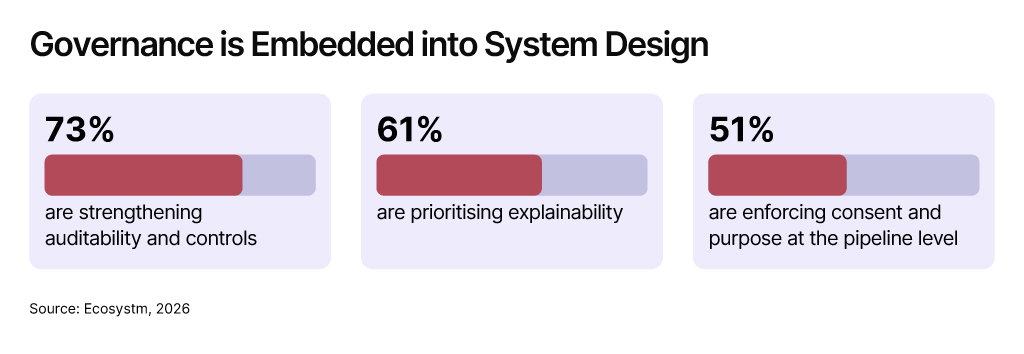
Earlier, governance tended to sit after systems were built, as a checkpoint before scaling. That separation is difficult to maintain with AI. Decisions around data usage, model behaviour, access control, traceability, and retention are now being defined as part of system design itself.
That changes the nature of governance. It moves from being something applied to systems, to something built into them. Policies still matter, but the real control sits in architecture and design decisions that determine what AI systems can actually do once they are in production.
3. Distributed data is raising coordination effort
Most organisations are moving to distributed data environments for practical reasons such as resilience, scale, and flexibility. But the operating reality is more demanding than expected.
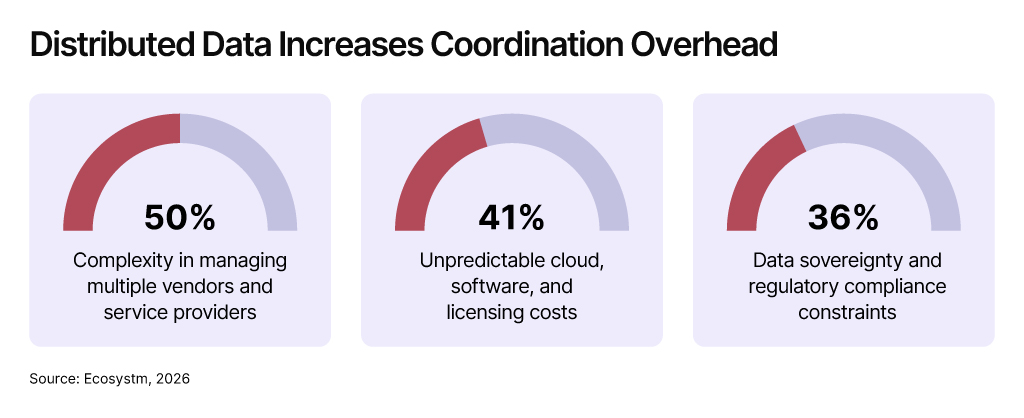
Data is now spread across multiple clouds, on-prem systems, and edge environments. That spread creates friction in access, definitions, and governance. The impact is visible in duplicated datasets, inconsistent definitions, and uneven data quality depending on where it is consumed.
AI sits directly on top of this environment. Its performance depends not just on whether the data exists, but also on whether it behaves consistently across systems. That is where IT and data decisions start to merge in practice – architecture influences how data behaves, and data distribution shapes system load and performance.
4. AI performance sits below the application layer
Modernisation efforts are moving attention away from individual tools toward system performance.
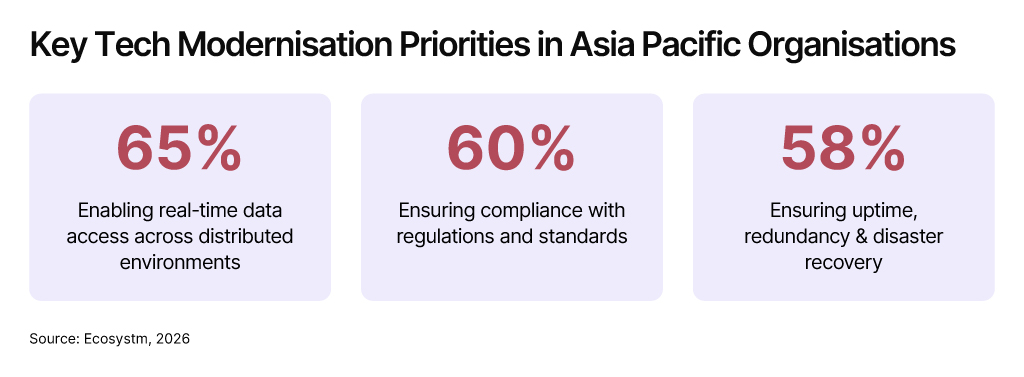
But several constraints keep resurfacing: rising cloud and infrastructure costs, interoperability issues across platforms, and uneven skills across legacy and modern environments. These issues sit across IT and data functions at the same time. Infrastructure teams focus on reliability and performance. Data teams focus on access and consistency. In distributed environments, those responsibilities overlap heavily, especially in integration and real-time operations.
This is why automation and AI-enabled operations are gaining traction, not as transformation programmes, but as a way to manage complexity that already exists in the environment. The underlying point is straightforward: AI performance reflects system design, not just model quality.
5. Trust sits across the system, not within one team
AI adoption is moving faster than most organisations can embed consistent trust and control.
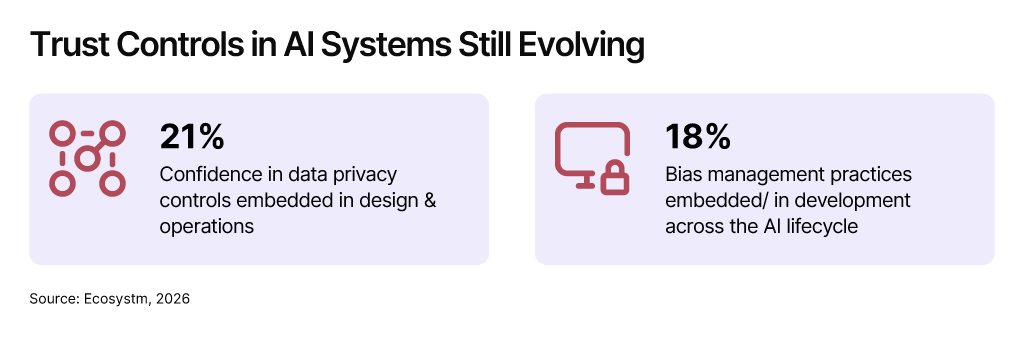
As AI moves into decisions, customer interactions, and operations, trust becomes part of how systems function, not just how they are governed. But trust does not sit in one place. It is distributed across data pipelines, infrastructure layers, applications, and security controls.
When issues arise – bias, leakage, inconsistent outputs – they rarely trace back to a single point. They tend to emerge through interactions across systems. That spreads responsibility across data, IT, security, and business teams, because each influences how trust behaves in real environments.
Why This Changes At the Leadership Level
The discussion has shifted from AI as a set of initiatives to AI as an operating condition.
The challenge is not activity or investment. It is whether the organisation is set up to carry AI from experimentation into repeatable performance.
That shows up in three areas:
- Clarity on where value will come from and what has to shift to enable it.
The constraint is rarely the use case itself. It sits in systems, data flows, and operating processes that determine whether the use case actually works in production. - Alignment across functions that now depend on each other. IT, data, security, and business decisions influence each other directly. Without alignment, optimisation happens in silos, while scale remains limited.
- Ownership of outcomes end to end. Activity is easy to track. Outcomes are harder. The gap between the two sits across multiple functions and only gets resolved when accountability connects across them.
The expectation is not technical depth; it is clarity on whether the organisation’s structure matches how AI actually operates. Because at this stage, the constraint is not exploration. It is the distance between how systems are built and how they need to work for AI to deliver at scale.